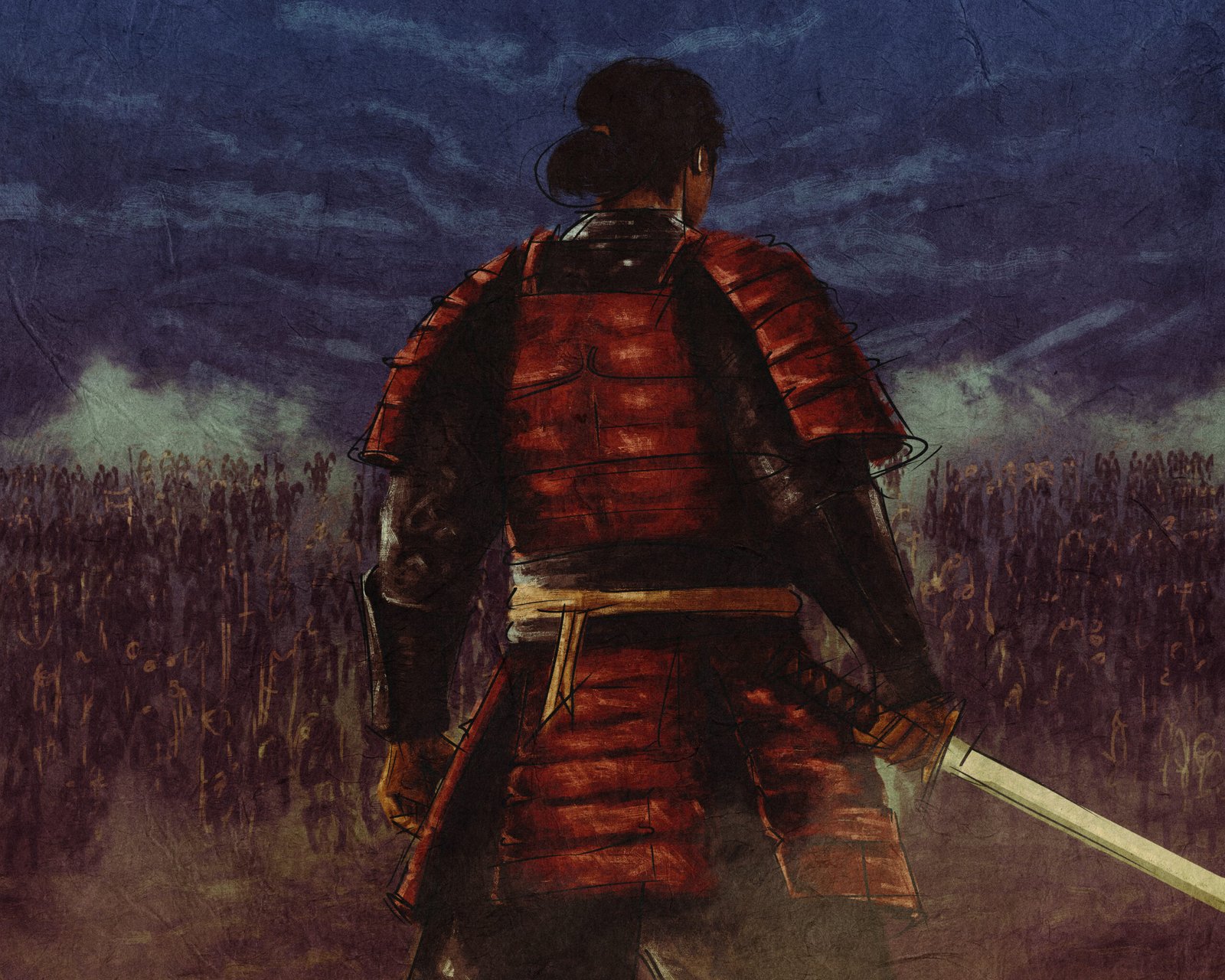
Against All Odds
Play background music as you read
♦ 03 Sept 2026
It was the ruthless reality of defeat in the battle of Sekigahara in the year 1600 that led him to this point. It was the thought of being without his revered lord Ishida Mitsunari that drove him to drift wounded and aimlessly along the dusty roads of Japan in search of new purpose, in search of new meaning to his life in a world that had lost its way. “I will never be defeated again”, he said as he lay on the side of the road, the ground watered with his own blood. The only thing keeping him alive was his will. Several hours had passed, and this young warrior found himself in the carriage of a farmer, no it was a merchant, or was it a monk? He couldn’t tell from the smell of pig dung, hay and sake in the carriage. His wounds were dressed, but he still felt pain, not from the wound but in his heart. The pain of knowing what he had now become, a wandering swordsman.
“Here’s an interesting fact about Japan at that time. Warring clans were always fighting one another in a bid to control territory and attain a higher level of honour and crystallise their family/clan name. These clans were led by powerful samurai families, whose head, the lord, was also seen as a spiritual leader. A samurai losing his lord means he no longer has a purpose, and so he becomes a wandering samurai, a disgrace, an anomaly, he becomes a ronin.
In the years that followed, this young swordsman devoted himself to attaining enlightenment, learning, seeking knowledge and technical perfection of his sword skills in a world ruled by blood and steel. He went about duelling everyone who was willing. “It is difficult to understand the universe if you study only one planet”, he said, when asked once by an opponent why he went about fighting. He put to practice all he had learnt since the battle at Sekigahara, but this wandering swordsman wasn’t satisfied with petty duels.
It was in 1604 that this wandering swordsman arrived in Kyoto, the capital city of this new world, with no name that mattered yet, and by the time he left, a school lay in ruins, a boy lay in the ground, and his name was cemented in the minds of all of Japan.
As all conflicts start, it started with pride. The Yoshioka were the finest blades this city had, with generations of mastery of the blade, and a name spoken with the kind of respect that keeps a family fed for a hundred years. Seijūrō led it, and he agreed to face this wandering swordsman, expecting to end him quickly. “I came to this city to defeat you” was the content of the letter this wandering swordsman sent to the house of Yoshioka. What Seijūrō didn’t know was that this wandering swordsman once defeated a seasoned samurai at age 13 with a bokuto; it was his first ever duel. Seijūrō, in his immaculate attire, waited for this young swordsman who came to the duel late. Furious at his lack of respect, Seijūrō cursed at him, “My blade is thirsty for your blood, and it is never denied”. He drew his katana and launched at this young swordsman, whom he thought was not worthy to participate in a duel of this proportion. His movement was swift and precise, you could tell the young swordsman was in for it. One blow to his left shoulder was all it took, and Seijūrō’s arm was broken. The disciples of the Yoshioka school who were watching took a step back in fear, the crowd that had gathered murmured softly at one another, they were in disbelief.
This young swordsman had arrived late on purpose to brew his opponent’s temper and use that against him. Seijūrō’s authority was broken by a bokuto, and he vanished into a monk’s robes soon after, finished as a swordsman before he’d finished growing old. The master of the Yoshioka house was defeated by the wooden sword of a wandering ronin.
“You see, 2500 years before this duel, the wisest king concluded that pride goes before destruction and a haughty spirit before a fall; Proverbs 16:18”
His brother came next, a few weeks after learning of Seijūrō’s defeat. He was angrier, faster, certain that blood would settle what humiliation couldn’t. Denshichirō didn’t leave the ground he fell on. Suffering the same fate as his brother, Denshichirō took a bokuto to his head, sealing his defeat. Now, two heads of the greatest school in Kyoto, undone by one man, in a matter of weeks. That kind of shame doesn’t stay quiet. Honour and pride lost to a 21-year-old boy. In this world, that was unforgivable. The moral code of Bushido demanded blood revenge. It curdled into something else, and the Yoshioka, whatever remained of them, stopped thinking like swordsmen and started thinking like men who had already lost.
They chose a child to stand at the front of their vengeance. He was only twelve years old, named the head of a broken house, sent out as bait while dozens of archers, spears, and blades hid in the trees around him. A boy’s life was offered up to bring down one man.
“How far can a man go to protect his pride and his name? Here’s what I think: It was a smart move to use a child; I think they thought the young swordsman would let his guard down in a duel with a child. Unfortunately for them, he was smarter, and the cost was the life of a boy who had nothing to do with their vendetta”
He was told the duel would happen at night, he thought it was an unusual hour for honour to be settled, and something in that struck him as wrong. So he came before them, hours early, and disappeared into the dark, waiting behind the great pine tree. No name, no army, just a man crouched still in the trees, watching the shape of a trap being built around empty ground.
When they came, he was already there. What followed was not a duel, first the thudding of the young leader’s head on the ground, the boy’s part in it ended fast and quiet, the way some things have to end when the weight of them is too much to look at directly. The wandering swordsman did not look back at it. It was the bell that started the match, and a storm was let loose. Steel against steel, spears thrusting and shouting, dozens of bodies moving to end one, and one man moving through all of them like something the trees themselves had decided to protect. Not one recognisable word was spoken, only agonising screams could be heard. Men fell in ways they hadn’t trained for. The ground did the counting, it was enriched with the blood of vengeful men, not anyone left standing. Oh, it was a beautiful-brutal display.
When the screaming and shouting had ended, and what was heard was the sound of men choking on their blood, he heard the voice of a dying man trying to speak, “Where did you come from?” The young swordsman moved to him, towering over him. He held his katana with both hands, ready to drive it into the heart of his opponent. “Who are you?” the dying man asked. “Watashi wa Miyamoto Musashi desu, and before I die, the world would know my name”, he said as he pressed his blade into his chest.
He disappeared into the rice fields, blood on him that wasn’t his own and blood on him that was. His name was Musashi. What was born that night in the dark outside Ichijōji did not stay a secret of one bad evening. It became a philosophy carved out of a massacre, a discipline built from the memory of standing utterly alone against everyone who wanted him gone. Against all odds, some things survive the fire meant to end them.